
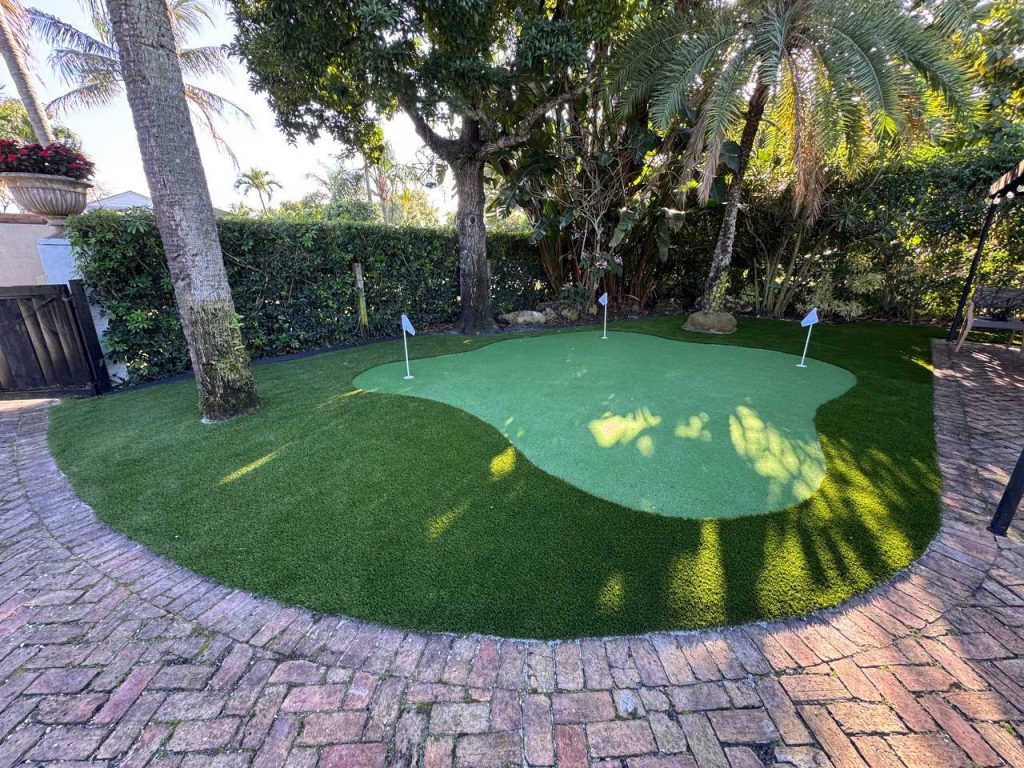
A backyard putting green should be planned around the shots you want to practice and the space you can use comfortably. Choosing an attractive green shape is only the beginning. Contours, cups, drainage, nearby windows and maintenance access all affect whether the finished area works for your household.
For a South Florida property, it is also worth observing the site during sunny and wet conditions. A putting surface is a designed system, not simply a different carpet placed on a lawn. Begin with a clear description of how you will use it, then ask the installer to explain how the proposed layout supports that use.
Decide what kind of practice you want
Think about the distances and breaks you hope to practice most often. A green for short putting drills does not need the same surrounding space as an area intended for chipping. Be realistic about ball flight, nearby people, pets and neighboring properties.
Discuss any proposed chipping use explicitly. A layout that is suitable for putting should not be assumed to contain airborne shots. If there is insufficient clearance, a putting-only design may be the more practical choice. Keep clubs and balls away from shared walkways while others are using the yard.
Work with the space, including its awkward parts
Measure the usable footprint after accounting for beds, paths, patios and access routes. Mark doors and gates that must remain clear. A design can look generous on a sketch while leaving too little standing room or creating an awkward route around a cup.
Ask to see the intended putting lines and player positions on the plan. You should be able to reach each cup, retrieve balls and move around without repeatedly stepping into a planting bed. If the space is limited, a simpler shape may create more useful practice than extra narrow extensions.
Discuss contours before choosing cup locations
A few carefully considered contours can create variety. Too much slope or too many dramatic features can make a small green frustrating to use. Describe your skill level and whether you prefer repeatable practice or more recreational challenges.
Cup placement and contours need to be considered together. Ask how each intended putting route relates to changes in slope. Do not assume that adding more holes automatically improves a compact area. The construction should also avoid creating low spots where water collects merely to make a break more noticeable.
Understand surface performance without expecting a guarantee
Ask about the specified putting product and what affects its roll characteristics. Installation, base smoothness, contours, infill where used and ongoing care can influence the result. A sample held in your hand cannot demonstrate how the complete green will play.
If a particular performance target matters to you, discuss how it will be described and assessed in the proposal. Avoid expecting a residential green to reproduce every condition of a particular golf course. Conditions and maintenance practices differ, and an unsupported speed promise is not a substitute for a clear specification.
Plan the fringe and transitions
Fringe can help define the green and connect it with the surrounding landscape. Its height and width should suit the intended use and available space. Ask how different materials meet and how the edge will be secured without creating an awkward step.
Think about where balls will finish when they leave the putting surface. Nearby drains, pool edges or planting gaps may make retrieval difficult. A modest adjustment to the layout can be more useful than discovering those conflicts after installation.
Give drainage equal attention
Observe where water crosses the proposed green during rain. Share any history of puddles, washouts or nearby irrigation leaks. The installer needs to consider the base and site grades, not just the drainage characteristics of the visible turf.
Ask how water will leave the area and how existing drains or access covers will remain serviceable. A smooth playing surface depends on a stable supporting system. Covering a drainage problem can leave both the yard and the quality of practice disappointing.
Make room for real maintenance
Putting greens need debris removal and product-appropriate care. Leaves, grit and displaced material can affect use, particularly around cups and transitions. Ask for written care instructions for every surface included in the design.
Check how you will reach the green with approved tools and how nearby gardening will be managed. Loose mulch beside a frequently used edge may require extra cleanup. Avoid storing furniture or equipment on the green unless the system has been assessed for those loads.
Questions before you approve a plan
Can a small yard fit a putting green?
Possibly. The useful practice area depends on clearances and layout as much as total square footage. Start with the shots you want to practice and the circulation space they require.
Does more contour make a better green?
Not necessarily. Contours should support your goals and fit the footprint. A simple, usable design may be more rewarding than one with excessive breaks.
Can I add cups later?
Ask during planning. Future changes can affect the base, surface and drainage, so additional cup locations should not be treated as an effortless adjustment.
Prepare for the design conversation
Bring a rough plan, photographs and a list of intended activities. Note whether the yard must also accommodate pets, seating or a route to another outdoor area. Turf performance depends on materials, installation quality, drainage, use and maintenance, including for a specialized putting surface.
Review putting greens and backyard golf areas and contact Royal Synthetic Turf to discuss your space. A useful proposal should explain the playable layout and supporting construction as clearly as the finished appearance.